What's that necklace you keep in your pocket?
- melina
- Feb 5, 2020
- 5 min read
Welcome (back) to my blog dear reader! I hope you enjoy your stay! 😄
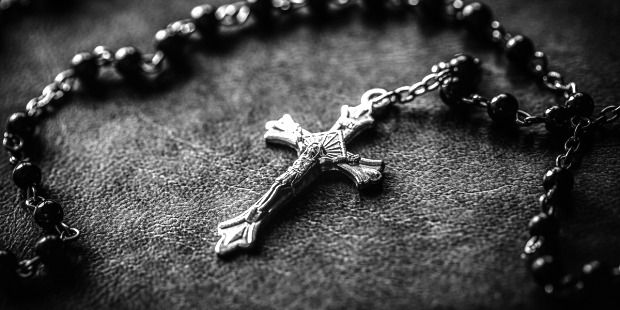
Today’s topic is super Catholic but I hope it is still enjoyable and informative! I would love your feedback either way. My Instagram DMs are always open. Today, I wanted to talk about “that necklace you keep in your pocket” (an actual question I’ve been asked), the rosary. I made a promise to myself: I would pray the rosary every day in 2020 and as of this post going live I have kept that promise, saying 36 rosaries so far. So. Where did the Rosary come from in the first place? And what has been my experience with praying the rosary and how has it changed in the last month or so?
I thought I would start with the history of the rosary. (Gotta put my two bachelor's degrees to use somewhere in this blog of mine.😄)According to a page I found on the Dynamic Catholic site, which I have linked, the rosary’s foundations are older than people may think. The first recorded use of the word “rosary” appeared in 1597.
The main prayer of the rosary is the Hail Mary. It took more than a thousand years to be put all together. “The earliest version simply added Mary’s name to the message delivered by the angel Gabriel to Mary: “Hail Mary, full of grace, the Lord is with thee” (Luke 1:28). Around 1050 AD, the words Elizabeth used to greet Mary during the Visitation were added: “Blessed art thou among women, and blessed is the fruit of thy womb” (Luke 1:42). In 1261, Pope Urban IV added the name of Jesus to the end of Elizabeth’s words.”
After another three hundred years, “St. Peter Canisius published the Hail Mary in his 1555 Catechism with almost the entire final petition: “Holy Mary, Mother of God, pray for us sinners.” Eleven years later, the Catechism of the Council of Trent (a work that Canisius was instrumental in creating) included, for the first time, the entire final petition, concluding with the words ‘now and at the hour of our death. Amen.’” The version Catholics use now was given official approval in 1568. Wow. The article I linked earlier goes into the history of praying with beads and how many a typical rosary has if you want to know more, dear reader.
So that is where the prayers come from, but what about the actual rosary? “It is widely believed that in 1214 St. Dominic had a vision of Mary. She is said to have presented him with the rosary, both the beads, and the prayers to be prayed.” It pretty much stayed the same until 1917.
“On May 13, 1917, Mary appeared to three shepherd children in Fatima, Portugal….On July 13, 1917, Mary asked the children to add a short prayer to the end of each decade of the rosary: O my Jesus, forgive us our sins, save us from the fires of hell; lead all souls to heaven, especially those in most need of thy mercy. Today this is referred to as the Fatima prayer, and many Catholics incorporate it into the rosary as Mary requested.”
The original mysteries of the rosary were introduced by Dominic of Prussia sometime between 1410 and 1439. The Joyful Mysteries: The Annunciation, The Visitation, The Birth of Jesus, The Presentation & The Finding of the Child Jesus in the Temple. The Sorrowful Mysteries: The Agony in the Garden: The Scourging at the Pillar, The Crowning with Thorns, The Carrying of the Cross & The Crucifixion. And The Glorious Mysteries: The Resurrection, The Ascension, The Descent of the Holy Spirit, The Assumption & The Coronation of Mary as Queen of Heaven and Earth. On October 16, 2002, Pope John Paul II proposed adding a new set of mysteries called the Luminous Mysteries: The Baptism of Jesus in the Jordan, The Wedding at Cana, The Proclamation of the Kingdom, The Transfiguration of Jesus & The Institution of the Eucharist at the Last Supper.
So, that is the history of the rosary as a whole, but what is the history of the rosary in my own life? When I was a toddler I had a multi-colored wooden rosary. It was basically a toy but my fingers got used to holding the beads and my parents always talked about the cross when I would hold it out to them. I learned the prayers of the rosary by the time I made my First Holy Communion and learned the order in which to pray them with the rosaries I received as gifts from my family. I still use one of them to this day. When I was in high school my homeschool group had a rosary club in the summers. We would go to someone’s house, have a picnic in their backyard and pray the rosary as a group. It was so much fun! In college there was a semester I would arrive super early for my 8 am class. (Nerd much? Wow) I would go to the chapel and pray while I waited. A couple of young women who were always there at the same time asked me if I wanted to pray the rosary with them. So twice a week we did. As a young adult, I have begun to take my faith more seriously and including the rosary. Which also meant that something changed in the last few months.
I actually started meditating on the rosary. Having seen The Passion of the Christ film it was a lot easier for me to picture what was happening in the Sorrowful Mysteries. Picturing the film as I prayed gave me an idea. This might be kinda controversial, but I thought, why not picture the mysteries like I was there? I started imagining being in the places where Jesus walked. I have been to plenty of weddings so the Wedding Feast at Cana was an easy one. Laughter, music, warmth from torches, Mary murmuring to Jesus about the lack of wine. For the Ascension, I imagined the sand of the beach on my feet, the sound of the waves, and the wind moving my hair. It made my prayer feel so much richer. And if you are wondering how I keep track of the bead I am on as I imagine, it is like when you listen to music and count your reps while working out. It takes practice. Starting with a booklet with pictures to look at while you pray is also great.
I hope you enjoyed this look into what my daily prayer looks like. Having a relationship with the Blessed Virgin Mary, as she draws me closer to her Son has brought me so much peace and joy. And dare I say, some beauty in the crazy.
☀️💙


Comments